
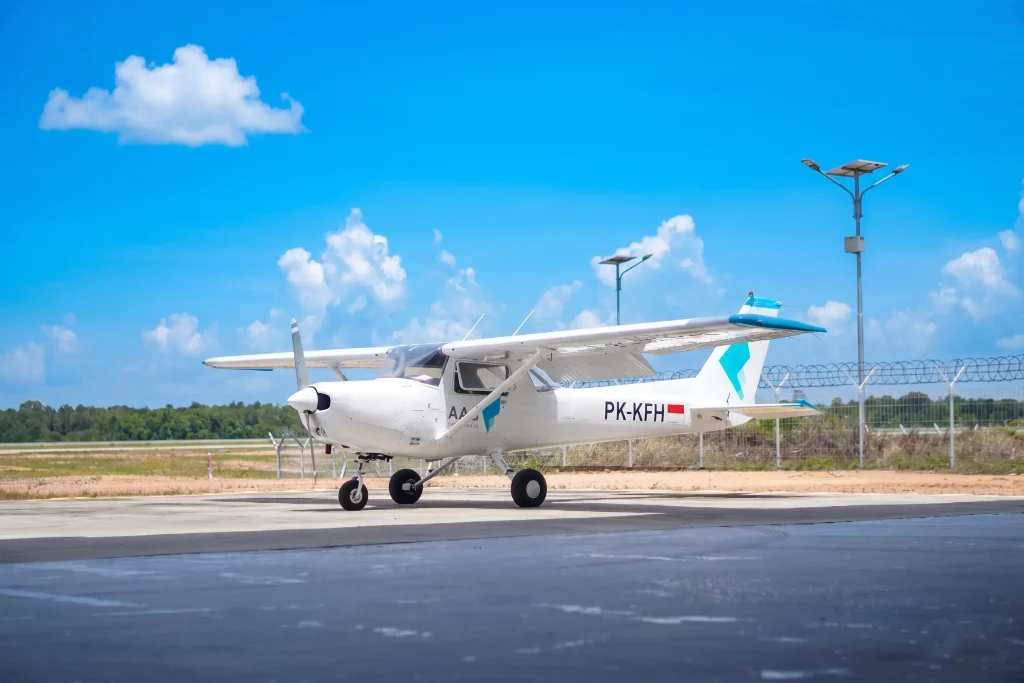
The global aviation training industry is an expansive and highly regulated ecosystem designed to transform novice students into proficient, commercial-ready aviators.
In Indonesia alone, the sector supports hundreds of thousands of active pilots, generating tens of millions of general aviation flight hours annually. At the absolute foundation of this pipeline lies the ab initio training phase, where the fundamental “stick-and-rudder” skills of flight are established.
Despite rapid technological advancements in the broader aviation industry, flight training has remained heavily tethered to an analog, all-metal, high-wing airplane for years. That aircraft is the legendary Cessna 152, which, remarkably, ceased production in 1985.
Understanding why the Cessna 152 became the global norms means I should do analysis and find data related to the fleet. Because in fact, fleet procurement for flight academies is not dictated merely by brand loyalty or historical inertia. Rather, it is driven by a highly specific convergence of aerodynamic pedagogy, mechanical durability, and stringent fleet economics.
Flight academies must balance the need for an aeroplane that is aerodynamically stable enough to forgive a student’s errors with the financial imperative to minimise direct operating costs and maximise aircraft availability.
While numerous training alternatives exist like the larger Cessna 172 and low-wing Piper PA-28s, these platforms often fall short of the Cessna 152’s benchmark. The 152 uniquely maintains a precise economic and operational equilibrium that modern competitors struggle to match.
However, the legacy Cessna fleet is not without limitations. Constraints regarding payload capacity and the degradation of performance in high-density altitude environments force academies in certain geographical regions to abandon the 152 entirely.
I believe through this writing I will try to provide a comprehensive examination of the Cessna 152’s dominance, analyse the operational compromises of its primary alternatives, and evaluate the regional climatic factors that dictate modern flight school fleet acquisition strategies.
Historical Evolution and the Genesis of the Cessna Trainer
The Cessna Aircraft Company’s dominance in the flight training market traces back to its establishment in 1927. After surviving the Great Depression and navigating the post-WWII era, the company identified a strong market for light, two-seater training aeroplanes.
This vision culminated in the 1957 launch of the tricycle-geared Cessna 150. It rapidly became the industry standard for primary flight training, achieving massive global success with over 23,000 units manufactured.
Despite this operational triumph, the Cessna 150 faced a critical infrastructural threat in the late 1970s. Its 100-horsepower Continental engine was originally certificated to operate on 80/87 octane aviation fuel.
As petroleum refiners phased out this fuel in favour of 100LL (low-lead) avgas, the Cessna 150’s engines began suffering from severe lead fouling and costly maintenance issues, forcing the company to adapt.
In response to this fuel compatibility crisis, Cessna introduced the Cessna 152 in 1977. The new model retained the highly successful thanks to significant changes from the C150 to the C152 and an increase to the maximum takeoff weight.
It also forgives the airframe of its predecessor but integrated a robust 110-horsepower Lycoming engine explicitly designed for 100LL fuel.
This critical engineering refinement resolved the lead fouling issues, provided a ten percent boost in horsepower, and created a legendary training aircraft that would dominate the global flight school environment for the next four decades.
Engineering the Ideal Trainer: The 150 to 152 Transition
The transition from the Cessna 150 to the 152 highlights the specific engineering iterations that optimised the aircraft for ab initio training. The upgrades extended beyond the powerplant, addressing aerodynamic safety and electrical modernisation.
| Specification | Cessna 150 | Cessna 152 | Pedagogical and Operational Implications |
| Engine | Continental O-200-A (100 hp) | Lycoming O-235-L2C (110 hp) | Eliminated 100LL fuel incompatibility issues; improved climb performance and density altitude margins. |
| Engine TBO | 1,800 hours | 2,400 hours | Provided a 33% longer lifespan between mandatory overhauls, drastically reducing hourly maintenance reserve costs. |
| Max Takeoff Weight | 1,600 lbs | 1,670 lbs | Enhanced payload flexibility, accommodating slightly heavier student and instructor pairings. |
| Electrical System | 14-volt | 28-volt | Allowed the airframe to support modern avionics, navigation packages, and enhanced lighting systems. |
| Maximum Flaps | 40 degrees | 30 degrees | Reduced the aggressive nose-up pitching moment during aborted landings (go-arounds), mitigating the risk of student-induced stall-spins. |
The restriction of the maximum flap deflection from 40 degrees to 30 degrees exemplifies a design compromise prioritising student safety over maximum aerodynamic capability.
While 40 degrees of flaps provided exceptional short-field landing performance, it created a massive drag penalty and an unprepared pitch-up tendency if the student rapidly applied full power for a go-around.
By mechanically limiting the flaps to 30 degrees, Cessna sacrificed marginal runway performance to eliminate a common cause of loss-of-control accidents in the training environment.
Aerodynamic Architecture and Flight Characteristics
The enduring appeal of the Cessna 152 in the training sector is inextricably linked to its aerodynamics.
A successful primary training aircraft must navigate a narrow aerodynamic paradox: it must possess sufficient inherent stability to forgive novice errors, yet remain responsive enough to provide clear, tactile feedback during fundamental manoeuvres.
The Pendulum Effect and High-Wing Stability
The defining visual and aerodynamic characteristic of the Cessna 152 is its high-wing, strut-braced configuration. Placing the aerofoil above the fuselage yields profound advantages for primary flight instruction. The most immediate benefit is visibility.
It means the high wing provides the student pilot with an unobstructed downward view of the terrain, which is vital for ground reference manoeuvres, dead-reckoning navigation, and maintaining situational awareness within a congested airport traffic pattern.
More critically, the high-wing layout alters the aircraft’s centre of gravity relative to its centre of lift, creating a pronounced pendulum effect.
Because the heavy fuselage and occupants are suspended beneath the wings, gravity inherently acts to pull the fuselage downward, providing the aircraft with a high degree of natural lateral stability.
If an atmospheric disturbance happens, such as a gust of wind, rolls the aeroplane into an uncommanded bank, the pendulum effect naturally seeks to return the airframe to a wings-level attitude. This innate stability reduces the cognitive workload on the student.
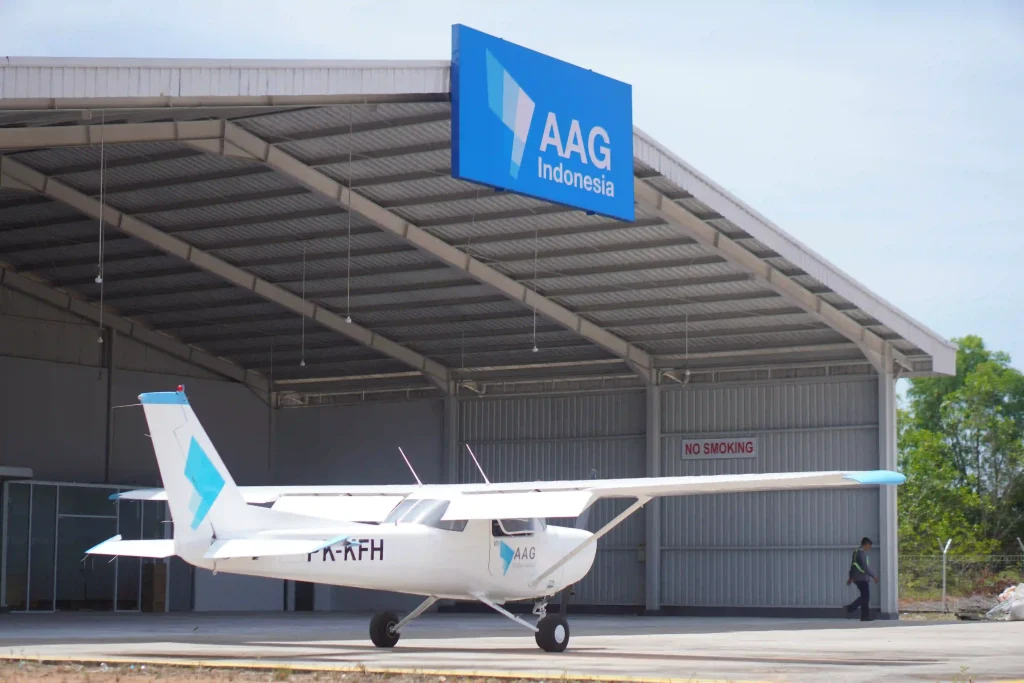
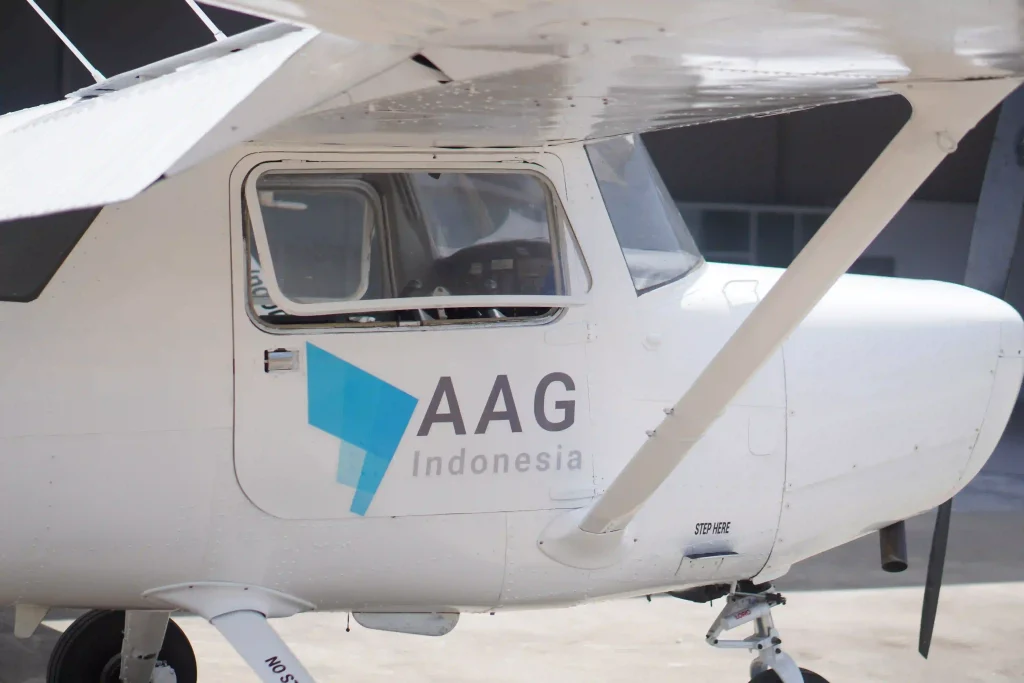
The stability allowing them to focus on procedural learning rather than constantly battling to keep the aircraft upright. It also increases the safety factors that become the main risk concern among flight training academies like AAG Indonesia.
Laminar Flow, Angle of Incidence, and Stall Characteristics
Aerodynamically, the Cessna 152 employs a low-aspect-ratio wing equipped with specific aerofoil profiles designed to prioritise low-speed handling over high-speed cruise efficiency. The angle of incidence is carefully calibrated to allow the aeroplane to generate substantial lift at lower speeds, which is essential for repetitive take-off and landing practice.
The aerofoil is designed to maintain smooth, laminar airflow over the wing’s surface, delaying the turbulent flow and boundary layer separation that ultimately lead to an aerodynamic stall.
When a stall does occur, the Cessna 152’s behaviour is highly docile and predictable. As the critical angle of attack is exceeded, the turbulent airflow striking the empennage provides ample physical warning in the form of airframe buffeting.
When lift is finally lost, the nose drops gently straight ahead, allowing the student to execute standard recovery procedures like reducing the angle of attack and applying full power with minimal altitude loss.
Spin Certification and Upset Recovery Training
A frequently overlooked factor contributing to the Cessna 152’s longevity is its structural and aerodynamic certification for intentional spins. A spin is an aggravated stall resulting in autorotation about the aircraft’s vertical axis.
The spin occurs when the aircraft stalls in an uncoordinated (yawing) flight condition. In this aerodynamic state, the wing on the inside of the turn stalls more deeply than the outside wing.
Resulting in a combination of high angle of attack, uncommanded roll, and continuous yaw as the aircraft descends in a corkscrew path.
Many modern training aircraft, particularly those certified under Light Sport Aircraft (LSA) categories, lack the structural rigidity or aerodynamic predictability required for intentional spin certification.
The Cessna 152, however, was rigorously tested to ensure safe entry into and recovery from incipient and fully developed spins. The aircraft requires deliberate, cross-controlled input from the pilot to initiate the spin and recovers predictably when standard anti-spin rudder and elevator inputs are applied.
Cessna expanded on this capability by manufacturing the A152 Aerobat variant, which featured reinforced structural components allowing for load factors of +6 and -3 Gs, along with quick-release doors and specialised safety harnesses. The ability to conduct spin training as a requirement for pilots pursuing their Certificated Flight Instructor (CFI) rating.
The Cessna 152’s utility category spin certification allows flight academies to utilise a single airframe for both primary student instruction and advanced instructor upset recovery training, eliminating the need to procure specialised aerobatic aircraft.
Economic Fundamentals of Fleet Management
While the Cessna 152’s aerodynamic forgiveness makes it popular among instructors, its financial profile makes it far more considered. Flight training is a high-cycle, narrow-margin enterprise that is heavily dependent on minimising Direct Operating Costs (DOC) while maximising the daily dispatch reliability of the fleet.
That means, flight schools or academies need to balance their expenditure and aircraft depreciation.
Capital Expenditure and Depreciation
The acquisition cost of a training aircraft dictates the baseline hourly rental rate an academy must charge to service its debt. Modern training aircraft require massive capital outlays. A new Diamond DA20 costs approximately $279,000, while advanced trainers like the Cessna 172S or Cirrus SR20 routinely exceed $400,000 to $600,000 on the used market.
In contrast, a used Cessna 152 can typically be acquired for between $20,000 and $55,000, depending heavily on the time remaining on the engine and the quality of its installed avionics.
This exceptionally low capital expenditure insulates flight schools from severe debt burdens. Furthermore, the Cessna 152 has essentially bottomed out its depreciation curve.
A well-maintained airframe purchased today can often be sold for nearly an identical price half a decade later, transforming the aircraft from a depreciating liability into a stable store of value. This is a financial burden that is able to close a flight school almost instantly.
Fuel Efficiency and Direct Operating Costs
Then comes the primary variable cost in flight operations is fuel consumption. The Cessna 152’s Lycoming O-235 engine burns an extraordinarily efficient 6.1 gallons per hour (GPH) at a 75 percent cruise power setting. During typical flight training operations, which involve lower power settings in the traffic pattern, this consumption can drop to between 5.4 and 6.0 GPH.
Assuming a global average Avgas (100LL) price of $6.00 to $7.50 per gallon (roughly 100.000IDR), the direct fuel cost to operate a 152 is roughly $35 to $46 per flight hour. When factored alongside insurance premiums, hangar fees, and maintenance reserves, the total operating cost of a Cessna 152 ranges from $100 to $175 per hour.
Surely this is how we count the price of our flight discovery. This positions the 152 as the most cost-effective certificated trainer globally, allowing students to maximise their repetition of fundamental manoeuvres for a fixed training budget.
The Lycoming O-235: TBO and Maintenance Simplicity
Now, the financial brilliance of the Cessna 152 is heavily reliant on its engine. The Lycoming O-235-L2C is a carbureted, normally aspirated, four-cylinder engine renowned for its mechanical simplicity and robust durability.
The critical economic metric for any aviation piston engine is the Time Between Overhaul (TBO). The Lycoming O-235 is able to achieve a TBO of 2,400 hours.
This extended lifespan significantly alters the hourly maintenance reserve calculations for fleet managers. A complete overhaul for a Lycoming O-235 typically ranges from $18,000 for a standard field overhaul to $28,000 for a premium factory rebuild.
When this cost is amortised over a 2,400-hour lifespan, the engine reserve drops to an extraordinarily low $7.50 to $11.60 per flight hour.
Additionally, because the Cessna 152 is a highly mature design with over 7,500 units manufactured, it benefits from an abundant global supply chain. Practically every licensed Airframe and Powerplant (A&P) mechanic is intimately familiar with its architecture.
The familiarity ensure that labour costs for routine 100-hour and annual inspections are kept to an absolute minimum. Also, the spare part availability is abundant even though the aircraft is already decades old.
Comparative Analysis of Alternative Training Aircraft
However, to really know why flight academies put their trust in Cessna 152 for decades even though there is advancement of technologies and models. We need to look at the alternatives that are available. It is necessary to evaluate why flight schools need to transition to alternative, modern airframes.
Analysing the competitors reveals that while modern alternatives may excel in specific metrics like cabin space, payload, or digital avionics. At the end, they still inevitably compromise the strict economic and pedagogical balance achieved by the 152.
The Cessna 172: The Larger Sibling
The most prevalent alternative to the Cessna 152 is the Cessna 172. With over 40,000 units produced since 1955, the 172 is statistically the most successful aircraft in aviation history.
The 172 utilises the same high-wing, fixed-tricycle-gear aerodynamic philosophy as the 152, but scales the airframe to accommodate four seats and a more powerful Lycoming O-320 or IO-360 engine producing 160 to 180 horsepower.
The primary advantage of the 172 is its payload capacity. It boasts a useful load of approximately 900 lbs, compared to the 152’s 500 lbs. This is critical for accommodating larger students, a second instructor for evaluations, or Garmin Avionics cockpit suites required for modern Instrument Flight Rules (IFR) training.
However, this capability comes with severe financial penalties. The heavier 172 burns 8.5 to 10 gallons of fuel per hour, drastically increasing direct operating costs. Consequently, hourly rental rates for a 172 are significantly higher, averaging $150 to $250 per hour.
Many academies mitigate this by employing a hybrid training syllabus, restricting students to the cheaper Cessna 152 for the first 25 to 30 hours of foundational training before transitioning them to the 172 for advanced cross-country and instrument navigation.
The capability of Cessna 172 is also the reason why AAG Indonesia utilises it to complement Cessna 152 limitation. You can learn more about Cessna 172 on our instruments page.
Mastering Performance: Understanding Operational Parameters
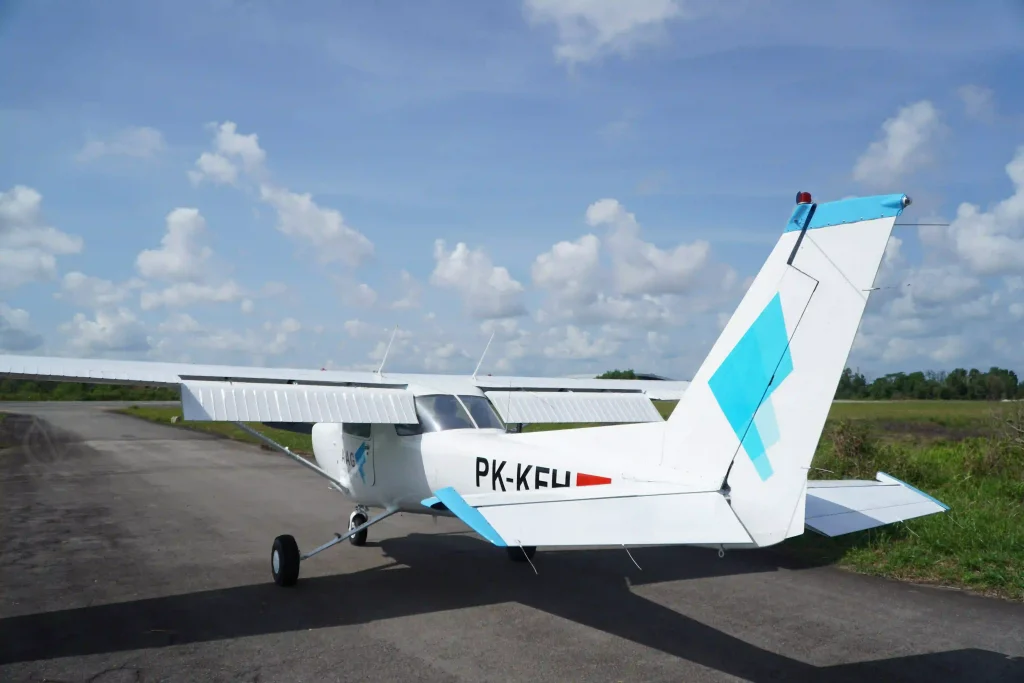
The Cessna 152 is celebrated for its efficiency and handling, but like any elite training instrument, it operates within specific performance parameters. Rather than being a “heavy lifter,” the 152 is a masterclass in precision.
It is specifically selected by AAG to teach cadets that aviation is a game of precision. Because it requires pilots to respect the fundamental relationship between aircraft performance, weight distribution, and environmental variables.
The Discipline of Weight and Balance
A key component of AAG’s syllabus is mastering weight and balance, and the Cessna 152 is the perfect classroom for this. With a maximum gross takeoff weight of 1,670 lbs, the aircraft requires cadets to be meticulously disciplined with their pre-flight planning.
Students must calculate fuel, passenger weight, and flight gear with total accuracy. This operational environment does more than teach math.
The knowledge will reinforces the professional discipline of meticulous planning. Careful planning will ensure cadets learn early that in professional aviation, safety is defined by knowing your aircraft’s precise capabilities. Even before you ever release the brakes.
Dynamic Learning: Density Altitude and Performance Management
Furthermore, the Cessna 152 provides an unparalleled opportunity to learn how to manage the effects of density altitude. While variations in temperature and humidity naturally influence air density, these factors serve as a vital training tool.
As AAG instructors we utilize these real-world conditions to teach cadets how to calculate performance margins and plan departures safely.
By learning to navigate these thermodynamic realities in the Cessna 152, our students develop deep situational awareness. This training hones the performance-based decision-making skills essential for any aviator.
These core competencies will serve them effectively throughout their entire professional careers. Whether they are flying light trainers or eventually commanding heavy commercial jets, this foundation ensures their success.
Archipelagic and Tropical Deviations: Why AAG Indonesia Trusts the 152
To truly appreciate the brilliance of the Cessna 152, one must first look at the massive shadow cast by its predecessor, the iconic Cessna 150. For years, the 150 served as the undisputed gold standard for civilian flight training, successfully introducing countless pilots to the skies.
However, as the global aviation sector expanded, the rigorous, repetitive daily demands of intensive flight school operations began to push the airframe to its limits.
The aviation market required an aircraft that maintained the Cessna 150’s famously forgiving flight characteristics. Additionally, it needed a more robust, heavy-duty framework capable of withstanding the relentless demands of student training. That is Cessna 152.
The 152 was a significantly modernized machine born from a critical functional shift in aviation: the widespread transition to 100LL (low-lead) aviation fuel. The 152 was engineered with a highly reliable Lycoming O-235 engine to run on the global fuel standard still used at modern training hubs like Batam’s Hang Nadim.
This purposeful redesign not only optimized the aircraft for the new fuel chemistry but also improved engine performance and longevity, transforming the plane into an operational workhorse.
Today, decades after its initial launch, the Cessna 152 is still enduring a production legacy that very few aircraft in history can rival. It is exactly this proven, unbroken track record of safety, durability, and mechanical dependability that explains why Approved Training Organizations (ATOs) globally continue to rely on it.
We at AAG Indonesia intentionally utilizes two Cessna 152 units for our programs and course because its foundational training capabilities simply cannot be replicated by modern automation.
By stripping away complex glass screens and forcing cadets to master pure stick-and-rudder aerodynamics, the Cessna 152 serves as the ultimate classroom to forge the resilient, highly aware aviators that major airlines demand.
Conclusion
The Cessna 152 remains the global standard for primary flight training because it uniquely balances aerodynamic stability with exceptional mechanical durability and cost-efficiency.
Its high-wing design offers superior visibility and natural stability, while its robust Lycoming engine and spin-certification make it an ideal, cost-effective platform for teaching foundational “stick-and-rudder” skills.
Although modern alternatives like the Cessna 172 offer greater payload and advanced avionics, they come with significantly higher operational costs and complexity.
While the Cessna 152 faces limitations regarding payload and performance in high-density altitude environments, its unmatched economic value ensures it remains a cornerstone of pilot training until a comparable, low-cost successor emerges.
Now, reading about the Cessna 152 is one thing, feeling its responsive, tactile flight characteristics in the air is another. Book your personalized Discovery Flight at our Batam campus today and experience firsthand why this legendary aircraft remains the gold standard for foundational pilot training.