
Imagine learning to pilot commercial aircraft just miles away from one of the world’s busiest aviation hubs. Here, you will navigate diverse coastal airspace completely free from the chronic congestion that becomes a problem in major metropolitan flight schools (like Singapore, Jakarta or Kuala Lumpur).
That’s why choosing the right location to launch an aviation career is just as critical as selecting the flight academy itself. Theoretical principles and basic stick-and-rudder maneuvers can be acquired in almost any airspace.
However, the specific operational environment where an ab-initio cadet trains directly dictates their command readiness and cockpit communication confidence. Ultimately, this foundational environment shapes their situational adaptability when transitioning to multi-crew transport aircraft.
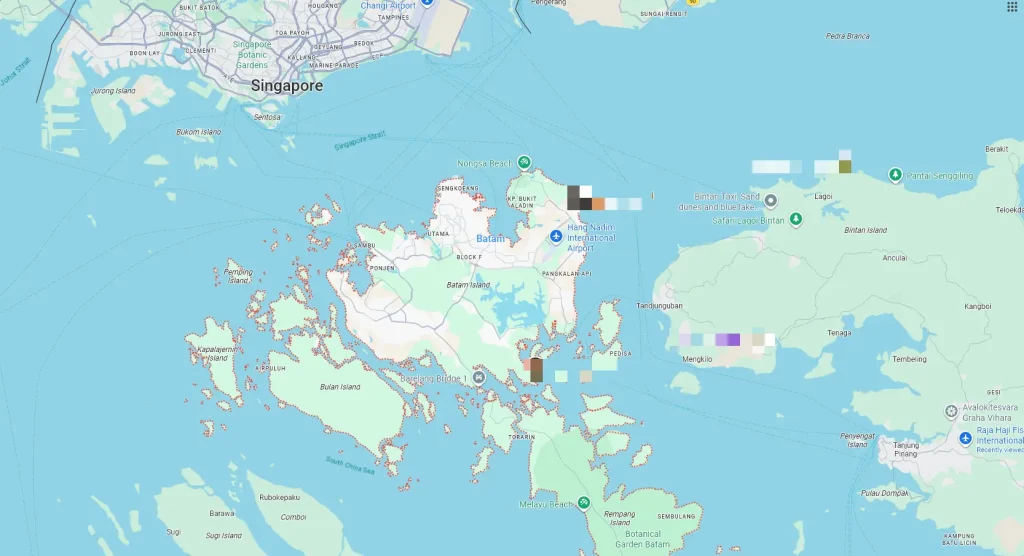
Batam, Indonesia, located in the Riau Archipelago just south of Singapore across the Singapore Strait, has rapidly emerged as a premier destination for aspiring commercial aviators.
Historically known as a maritime trade enclave and manufacturing center, the island now occupies a unique intersection of sovereign airspace, intercontinental aerodrome infrastructure, maritime geography, and regional economic competitiveness.
By considering the unique geography, infrastructure, and economic dimensions of aviation training in the Riau corridor, this article will show you the seven definitive reasons why Batam serves as the ideal aviation training hub for the next generation of professional airline pilots and aviation talents in Southeast Asia.
1. Strategic Location to International Airspace and Cross-Border Air Traffic Exposure
A major flaw of common flight schools in remote rural areas is that they are disconnected from real-world flight operations. Cadets often trained in quiet, uncontrolled skies frequently face severe communication anxiety and cognitive overload upon graduation.
Consequently, they have to transition into dense, radar-controlled terminal airspace which becomes an overwhelming operational challenge. Batam bridges this training gap by exposing student pilots to busy international air traffic and complex routes right from their very first flights.
Batam and the Riau Islands sit directly beside one of the world’s premier aviation corridors, anchored by Singapore Changi Airport (SIN) which ranked the fourth busiest globally. The operational infrastructure of Batam aviation sector was modernized on March 21, 2024, when Indonesia and Singapore formally implemented a historic realignment of their Flight Information Regions (FIRs).
Under this framework, the Jakarta FIR (WIIF) expanded to cover all sovereign Indonesian airspace over the Riau and Natuna islands, an expanse previously administered under the Singapore FIR (WSJC) since 1946.
The ratified agreement delegates civil air traffic management services up to 37,000 feet in designated sectors close to Changi’s terminal paths to Singapore Air Traffic Control (ATC), supported by continuous Indonesian liaison personnel stationed directly within the Singapore air traffic center.
| Operational Metric | Batam International Training Corridor | Isolated Rural Flight Training Aerodromes |
| Airspace Interface | Active interface between Jakarta FIR and Singapore FIR | Uncontrolled Class G or isolated Class D airspace |
| Radio Phraseology Standard | Strict, fast-paced ICAO English radiotelephony | Casual, low-frequency, non-standard local phraseology |
| Traffic Density Profile | Heavy commercial mix (wide-body, narrow-body, turboprop) | Sparse light general aviation and agricultural aircraft |
| Separation Requirements | Radar-vectored commercial approach sequencing and wake profiles | Visual self-separation, standard circuit traffic |
| Cadet Situational Awareness | Continuous three-dimensional mental mapping of high-speed traffic | Limited exposure to complex terminal operating areas |
These regulatory and operational factors, places Batam-based student aviators in constant proximity to dense global traffic patterns funneled into Singapore Changi Airport, Seletar Airport, and Batam’s Hang Nadim International Airport.
Cadets must demonstrate precise compliance with standard ICAO radiotelephony in English, maintain radio discipline, and continuously anticipate the actions of nearby commercial airliners operating on adjacent flight paths.
Therefore, controlled and high-density terminal airspace does not remain a foreign or intimidating domain for student pilots trained in Batam. Instead, they assimilate active radar sequencing and cross-border navigational awareness as second nature. This foundational confidence significantly accelerates their overall readiness for airline line operations.
.
2. Aviation Infrastructure at Hang Nadim International Airport
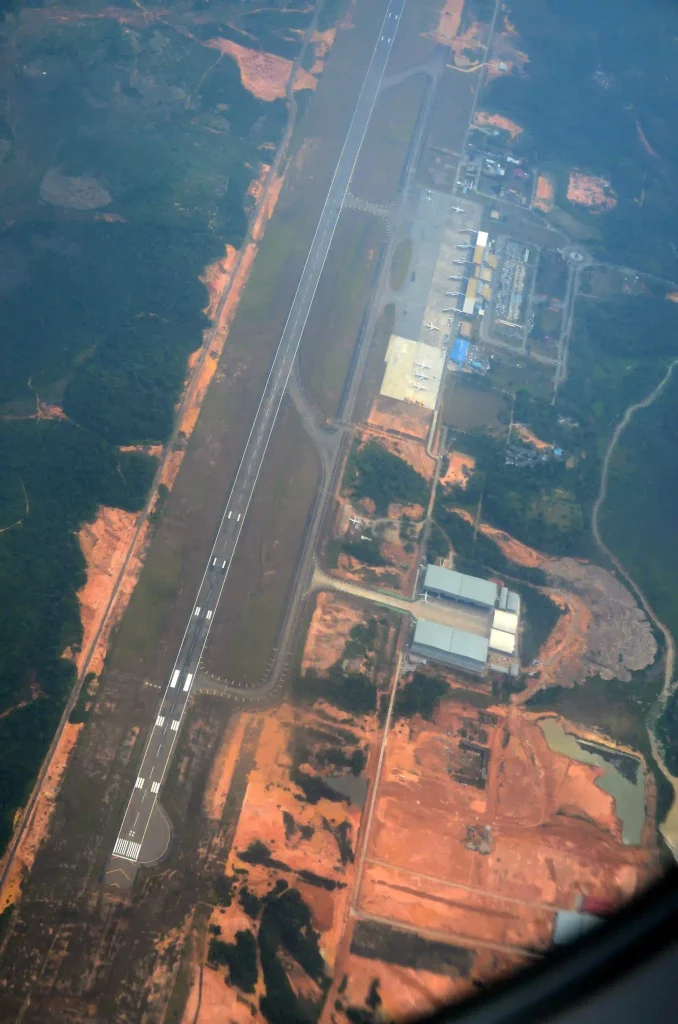
The physical specifications of an academy’s primary operating base establish a firm boundary for the scope, safety, and fidelity of flight operations. Flight training in Batam is centered at Hang Nadim International Airport (BTH/WIBB), a commercial facility engineered to full international standards. This puts aviation training like AAGID different from typical secondary flight training airfields with constrained dimensions which provides cadets with ideal operational flight training right from day one .
Hang Nadim features Runway 04/22, an asphalt runway measuring 4,028 meters (13,218 feet) in length and 45 meters in width. It is the longest operational runway in Indonesia and one of the longest commercial runways in Southeast Asia. The runway originally developed with the capacity to handle fully laden Boeing 747, Boeing 777, and Airbus A380 operations.
For flight training centers such as Alpha Aviation Group (AAG) Indonesia, this runway offers extraordinary operational safety margins. Ab-initio cadets conducting primary circuit training, touch-and-go drills, simulated engine failures on takeoff, and crosswind landings in single-engine trainers benefit from a safety buffer, minimizing the risks that accompany student training on constrained 1,000-meter rural strips.
| Aerodrome Specification | Hang Nadim International Airport (BTH) | Typical General Aviation Flight Strip |
| Runway Dimensions | 4,028 m × 45 m (Asphalt, Category 4E/4F capable)4 | 900 m–1,400 m × 23 m–30 m (Asphalt/Grass) |
| Navigational Instrumentation | Full Category I Instrument Landing System (ILS), RNAV/GNSS3 | Visual approaches or basic non-precision VOR/NDB |
| Operational Hours | 24-Hour Continuous Operations4 | Daylight VFR only or restricted tower hours |
| Total Land Reserve | 1,800 Hectares (~40% active utilization)4 | 50–150 Hectares (High spatial constraint) |
| Management Structure | Angkasa Pura I & Incheon International Airport Consortium | Municipal or privately owned aerodrome |
Operating at only about 40 percent spatial utilization, the 1,800-hectare airport estate has plenty of room to expand. Therefore it can seamlessly support both commercial flights and flight academies without running into tight slot constraints.
There is also ongoing development of Terminal 2 (completion target in 2026) and upgraded airside infrastructure to ensure that Hang Nadim matches the technological baseline of global international hubs. These enhancements directly modernize the airport’s instrument approach facilities, taxiways, and ground control systems.
As a result, student pilots would be trained within a professionally managed aerodrome environment throughout their syllabus. This real airport terminal environment exposure gives cadets a seamless transition to high-density commercial operations.
3. BTH is a Direct Co-Location with Commercial Airlines and the Expanding MRO Ecosystem
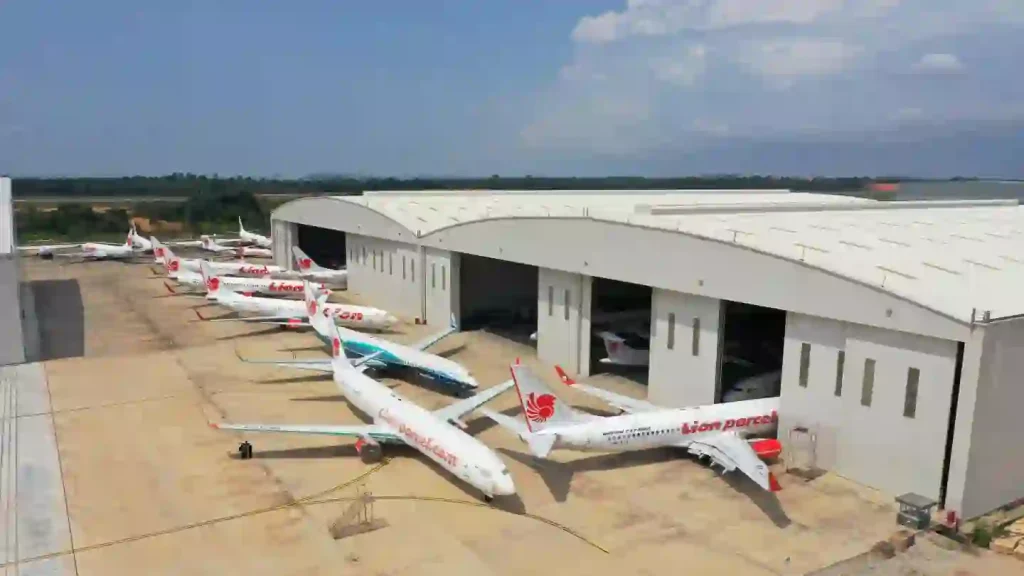
The most important transition moment between a cadet and a pilot is their exposure to a real commercial operation. That means they have to adapt and be used to a general aviation airfield to the fast-paced, high-hazard ramp of a major airline hub. In Batam, this transition is integrated into training from day one through the shared operation of Hang Nadim, where student training flights operate directly alongside scheduled passenger fleets, military aircraft, and maintenance facilities. All into one place. A uniqueness that is almost rare in any aviation training center.
Today, Hang Nadim serves as a key operational hub for several of Indonesia’s largest passenger carriers, including the Lion Air Group, Citilink, Super Air Jet, and Garuda Indonesia, alongside seasonal international long-haul services.
Concurrently, the airport hosts the Indonesian Air Force’s Lanud Hang Nadim (Type-C Base), requiring student cadets to navigate a mixed-traffic environment. That includes commercial airliners, airforce military training, and tactical training aircraft. Sharing the runway with heavy airliners also teaches cadets crucial airmanship skills: keeping safe spacing, handling jet blast, and avoiding wake turbulence.
Further Batam’s position as a regional aviation hub is strengthened by the Batam Aero Technic (BAT) Special Economic Zone, which sits directly on the Hang Nadim airfield. Cadets witness heavy aircraft maintenance, repair, and overhaul operations daily.
Here, student aviators walk the same ramp corridors and observe heavy airframes undergoing line maintenance, structural overhauls, engine teardowns, and post-maintenance test flights. This shared ecosystem demystifies commercial airline engineering, grounds cadets in practical aviation management, and instills a professional aviation culture long before they sit for their first airline type rating.
Other than that, AAG Indonesia as the International Center for Aviation Training has potential to become a complete training center for this vast aviation ecosystem. Which is an undeniable advantage compared to another academy.
4. Batam Has Optimal Year-Round Tropical Flying Weather
Training economics and student progression depend heavily on weather reliability. In temperate flight training regions across North America, Europe, and northern Asia, academies routinely lose two to four months of training capacity each year due to seasonal winter disruptions, sub-zero temperatures, low-level icing, blizzards, and lingering frontal fog. These prolonged groundings delay commercial license completion, increase student accommodation costs, and degrade procedural muscle memory between flight phases.
Batam’s equatorial maritime climate has a different nature. Located at approximately 1° North latitude which is the only one in the world (the closest one in Tropicbird Flight Service, Hawaii). The coordinate gives the Riau Archipelago steady surface temperatures year-round, with average daily highs of 30°C to 32°C and overnight lows around 24°C to 26°C. Freezing levels in this equatorial zone remain elevated above 14,000 feet, which virtually eliminates structural airframe icing hazards during low-altitude visual and instrument training flights.
| Climate Parameter | Batam (Riau Archipelago) | Continental / Temperate Flight Hubs |
| Average Annual Temperature | Consistent 28°C–32°C year-round. | Severe seasonal fluctuation (-10°C to 35°C) |
| Winter Grounding Downtime | 0 Months (Frost- and snow-free) | 2 to 4 Months (Snow, freezing fog, surface ice) |
| Convective Pattern Structure | Predictable diurnal maritime cells, rapid clearing. | Frontal cyclones, squall lines, persistent stratus |
| Standard Program Duration | 15 to 18 Months (Ab-initio Zero-to-CPL/IR) | 18 to 26 Months (Extended by winter delays) |
| Operational Dispatch Reliability | Consistent year-round flying slots. | Volatile, clustered during short summer windows |
Although Batam gets seasonal tropical rain, it mostly falls as short, daily local thunderstorms. Because afternoon storms build predictably and clear out within 60 to 90 minutes, flight schools easily schedule around them: cadets fly in the clear morning air and use stormy afternoons for ground school or simulator training.
As a result, cadets complete structured ab-initio courses in 15 to 18 months, dramatically cutting down the training delays common in higher-latitude environments.
5. Diverse Archipelagic Geography for Multi-Regime Flight Mastery
A comprehensive flight syllabus requires geographical variation to build resilient navigation skills. Training on featureless plains or uniform desert basins often produces pilots with limited visual reference skills and underdeveloped dead-reckoning ability. The archipelagic geography of the Riau Islands provides a dynamic setting that naturally sharpens student navigation and weather awareness.
Batam is ringed by an intricate matrix of islands, including Bintan, Rempang, Galang, and Karimun. Those islands interspersed with open maritime straits and active commercial shipping routes. This coastal environment provides clear visual landmarks, allowing cadets flying Visual Flight Rules (VFR) to practice map-reading, terrain orientation, and coastal dead reckoning alongside onboard satellite navigation.
Concurrently, the interaction between maritime moisture and solar heating produces varied local cloud layers, exposing cadets to real-world transitions between visual flight and Instrument Meteorological Conditions (IMC).
Student pilots learn early how to interpret weather developments, cross-check flight instruments, and manage inadvertent IMC safely under the supervision of seasoned instructors.
Batam also gives navigation exercises from cross archipelago’s airfields, such as Raja Haji Fisabilillah Airport in Tanjung Pinang, Bintan (also Indonesian Jurisdiction), to conduct complex over-water cross-country routes.
These routes require cadets to master position reporting, manage variable maritime winds, and calculate fuel reserves accurately while transitioning between ocean channels and island airspaces. The varied topography also produces localized sea-breeze fronts and coastal wind shears, giving cadets valuable practice in maintaining approach stability and handling crosswinds on landing.
By training across this archipelagic landscape, student pilots develop adaptable flying skills and seasoned judgment well suited for global airline pilots.
6. Batam Has High-Value Training Economics, Cadet Living Standards, and Regional Accessibility
This part should be a single complete article, but we will give you a slight picture. We totally understand that pursuing an ab-initio commercial pilot license requires a substantial financial commitment, which often places a heavy burden on aspiring aviators and their families.
The total costs encompass both direct aircraft and simulator fees, as well as the substantial living expenses accrued over more than a year of continuous study. This is why Batam presents a compelling cost arbitrage: it delivers an international training standard just 30 kilometers south of Singapore, but within a much more favorable cost environment.
In Singapore, completing a Commercial Pilot License (CAAS CPL) can exceed SGD $150,000 to $200,000, driven by the city-state’s high cost of living, severe airspace restrictions, and expensive aerodrome operations. Or in Malaysia, the cost can exceed RM440.000.
Batam, by contrast, operates under an Indonesian cost structure while adhering to rigorous ICAO and Indonesian DGCA safety standards. Batam living cost allows student pilots to optimize their training budgets, directing capital toward advanced certifications such as Multi-Crew Cooperation (MCC), Jet Orientation Courses (JOC), and Airline Transport Pilot License (ATPL) theory rather than high living overhead.
| Living and Operating Expense Category | Batam, Indonesia | Singapore Metropolitan Area | Cost Variance Advantage |
| Comprehensive Cost of Living Index | ~$540 per month baseline | ~$3,100 per month baseline26 | Batam is ~82% less expensive |
| Single-Bedroom Rental Rates | ~$160–$290 per month | ~$2,300–$3,100 per month27 | Batam is ~88% less expensive29 |
| Dining, Sustenance, and Groceries | Nominal local consumer cost | High global capital tier index27 | Batam is ~65% to 75% cheaper29 |
| Estimated 15-Month Living Expense | ~$8,000–$11,000 tota. | Exceeds $45,000 total26 | Over $34,000 preserved capital |
| Transit Access to Primary Global Hub | 45-minute high-speed ferry. | Direct internal urban transit | Seamless international mobility |
Beyond financial advantages, the region supports a balanced lifestyle that helps cadets manage the stress of flight training. Training academies maintain structured residential setups; for example, AAG Indonesia houses cadets in dedicated student accommodations on neighboring Bintan and in Batam, providing a quiet, focused academic setting supported by reliable transit to flight lines and classrooms.
Cadets also have easy access to modern urban conveniences, including major retail complexes like Grand Batam Mall and Batam City Square, healthcare facilities, and varied dining choices. During downtime, students can recharge at regional leisure destinations, such as the Crystal Lagoon at Treasure Bay Bintan, the scenic Bintan Blue Lake, and local coastal resorts.
Additionally, Batam’s regional connectivity makes it practical for international students: frequent high-speed passenger ferries run from Batam Centre, Sekupang, and Nongsa to Singapore’s HarbourFront and Tanah Merah terminals in just 45 minutes, with additional direct ferry routes linking to Johor Bahru, Malaysia. Cadets enjoy immediate access to Singapore’s intercontinental transit network while benefiting from Batam’s affordable, focused training environment.
7. Batam Has Expanding Commercial Airline Ecosystem and Accelerated Career Pathways
The ultimate measure of any flight academy is its ability to place graduates into airline cockpits. Batam’s growth as an aviation education center comes at an opportune moment, coinciding with an extensive multi-decade demand cycle for commercial pilots across Southeast Asia.
Projections from Boeing’s Pilot and Technician Outlook (PTO) 2025–2044 estimate that the global commercial aviation sector will require 660,000 new commercial pilots and 710,000 new technicians over the next twenty years to replace retiring crews and support fleet growth.
Southeast Asia stands out as one of the fastest-growing aviation markets in the world, with regional carriers projected to recruit 62,000 new pilots and 78,000 technicians over the forecast window.
| Aviation Personnel Metric (2025–2044) | Southeast Asia Market | Worldwide Commercial Fleet |
| New Commercial Pilot Demand | 62,000 | 660,000 |
| New Aircraft Maintenance Technicians | 78,000 | 710,000 |
| New Cabin Crew Personnel | 103,000 | 1,000,000 |
| Total Projected Aviation Workforce Need | 243,000 | 2,370,000 |
| Commercial Narrow-Body Crew Ratio | 10 to 12 Pilots per airframe | 10 to 12 Pilots per airframe |
This pilot demand is fueled by aircraft order books among Southeast Asian low-cost and flag carriers. Such as Lion Air, Batik Air, Citilink, AirAsia, Cebu Pacific, and Vietjet which are expanding their fleets to connect the region’s archipelagic economies. Because airlines require 10 to 12 pilots per operational narrow-body aircraft, carriers maintain active recruitment pipelines for qualified, well-trained First Officers.
Academies based in Batam like AAGID align our training directly with this commercial airline demand. For instance, Alpha Aviation Group Indonesia headquartered at Mega Techno City with flight operations at Hang Nadim structures its Airline Pilot Pathway Program specifically around airline recruitment standards. Cadets train on foundational trainers instruments like the Cessna 152 and Cessna 172 also combined with DGCA-certified Redbird MCX full-motion simulators for complex instruments.
By combining thorough ground theory with JOC, MCC, and ATPL coursework, AAGID is able to train graduates who are fully prepared for multi-crew airline cockpits. The shared apron with scheduled airlines, active MRO centers, and regional operator bases creates natural networking and recruitment avenues, transforming Batam into a vital talent pipeline for Southeast Asia’s aviation industry.
Conclusion
Finally, based on that evidence, Batam is undeniably the ideal aviation training hub in South East Asia if not in the world. No wonder when we talked to AAGID Chief Flight Instructor, Raymond Du Quesnay, he said AAGID is the best flight academy as mentioned in 4 Reasons Why AAG is One of the Best Flight Academy in Indonesia. Now the choice is back to you as a cadet or as a guardian of a cadet. Becoming a cadet with AAGID is a definite investment that is fair and has prospects in the future.
If you are ready to consult or enroll, go ahead contact our admission officer through Whatsapp +6281196955717 or email at id.info@aag.aero. AAGID definitely will help your need to start and launch an aviation journey.